
When the wind takes a tree down, John picks up.
Over 30 years of cleaning up after North Dakota storms, wind, hail, ice, and the occasional tornado. Same-day response in McLean, Burleigh, Morton, Oliver, and Sheridan counties. Yard walked clean before we leave.
Same-day response
Call by noon, John’s usually on-site for an assessment that same afternoon. Most cleanup starts within 24–48 hours.
Full documentation
Detailed invoice and before/during/after photos sent at the end of every job, for your records.
Full debris haul
Trees, limbs, brush, and chips all hauled off-site. Yard raked. Driveways and gutters cleared.
No fly-by-nights
Locally owned ND LLC, with a real address. Not an out-of-state storm chaser who leaves a mess.
What happens when you call John after the storm.
No invoice surprises, no salesman delay, no waiting for someone to fly in from Bismarck. Here’s the actual sequence from the call to a cleared yard.
The pattern is the same whether it’s a single limb across the driveway or a 60-foot cottonwood on the garage roof. John works it the same way every time, because the steps are the steps.
1. You call or text.
John answers his own phone. If he can’t pick up because he’s in the bucket or running a saw, he calls back as soon as he’s down. Text a photo and an address and he can usually give you a ballpark and a window before he even leaves the shop.
2. He shows up to look at it.
Same-week, often same-day if the property is in immediate danger. He walks the job with you, looks at access for the rig, identifies the propane tank, the septic field, the sprinkler heads, and the dog. Then he writes you a flat-rate quote on the spot. No “we’ll send it to you Monday.”
3. The work gets done.
The price John quoted is the price you pay. Brush gets chipped or hauled. Logs get bucked and stacked on-site if you want the firewood, hauled off if you don’t. The yard gets raked and walked before he leaves so you’re not finding chainsaw chunks in the lawn next spring.
If you’ve got a tree that’s been on your mind, leaning the wrong way, dropping limbs, looking unhealthy, the call before storm season is a fraction of the cost of the call after. Same advice John gives every customer.
Every kind of mess Mother Nature can make.
If the wind, hail, or ice broke it, John has handled one like it before. Quoted on-site, fair pricing, locally owned.
Downed Trees
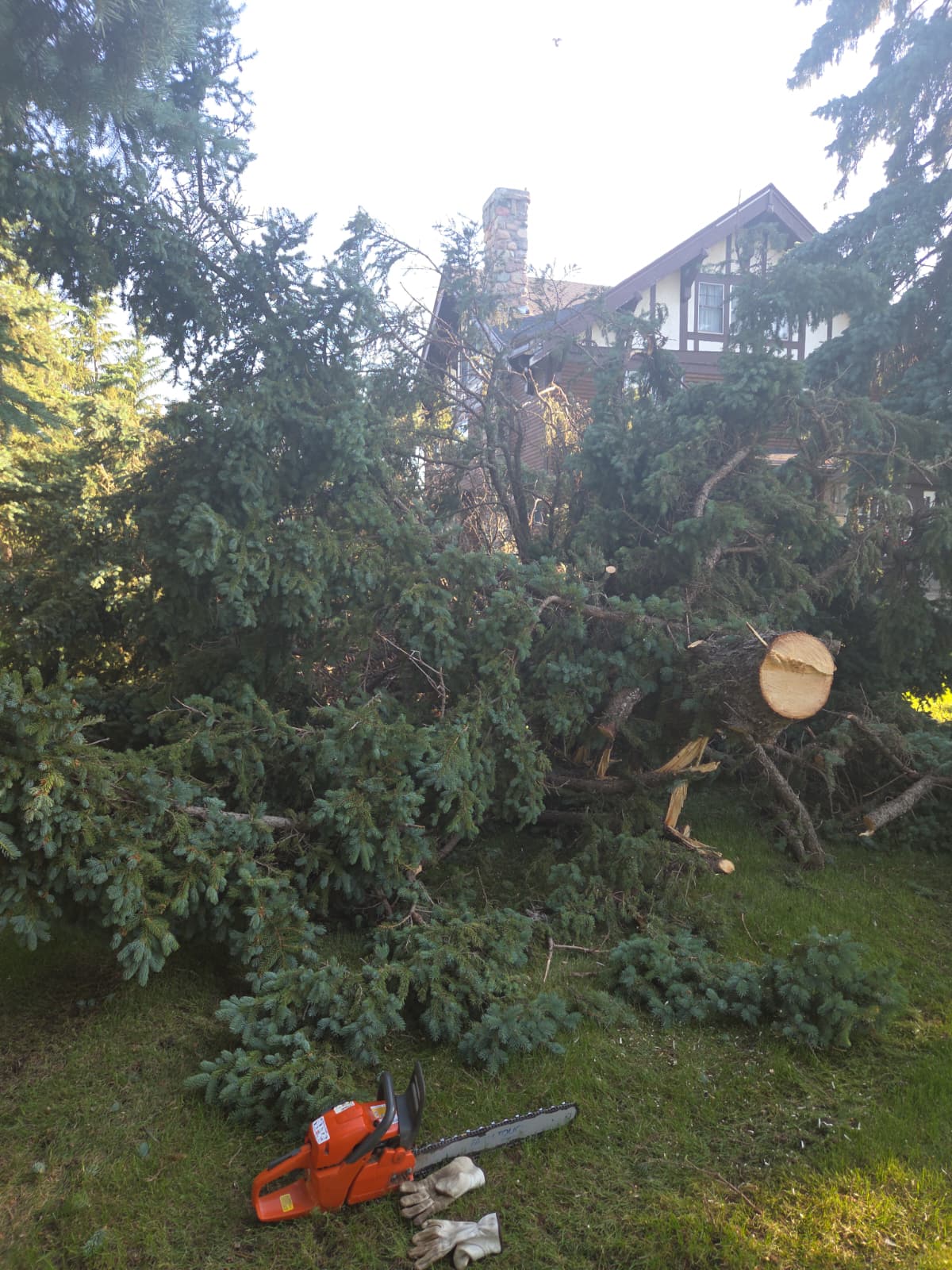
Trees uprooted, snapped at the base, or pushed onto fences, sheds, or vehicles. Full removal, brush haul, and yard cleanup.
Quoted on-site, flat rateTrees on Structures
Trees on homes, garages, pole barns, or outbuildings. Carefully rigged off the structure to prevent further damage.
Quoted on-site, flat rateHung-Up Limbs
Broken branches caught in the canopy (“widow-makers”). The most dangerous post-storm hazard, handled fast and safe.
Quoted on-site, flat rateLeaners & Hazardous Trees
Trees the storm partially uprooted or split. Often the silent threat that needs to come down before the next wind event.
Quoted on-site, flat rateYard Debris Cleanup
Properties with significant brush, broken limbs, and storm debris. Chipping, hauling, raking, all of it.
Quoted on-site, flat rateFarmstead & Shelter-Belt Damage
Wind events frequently take out sections of shelter-belts and windbreaks. Full assessment, removal, and replant prep.
Quoted on-site, flat rateWhere John drives during a storm season.
Within roughly a 100-mile radius of Washburn. Highlighted counties below are where the heaviest storm-cleanup demand has historically come from, and where John has the deepest network of past customers.
What folks ask in the hours after a storm.
How fast can you get out here after a storm?
Usually within 24 hours for an on-site assessment, often the same day if you call early. Active cleanup typically starts within 48 hours. After a major regional event we triage by hazard, trees on houses and blocking access come first, yard cleanup comes once the urgent jobs are handled.
I have a tree leaning toward my house, should I wait or call now?
Don’t wait. Leaners and partially uprooted trees are the silent danger after a storm. A windless day can still drop a compromised tree, and they cost significantly more (and become more dangerous to remove) once they actually fall. Call for a same-day or next-day assessment.
What if out-of-state storm chasers show up at my door first?
Politely turn them away. Out-of-state storm-chase crews are notorious for disappearing with deposits, leaving debris piles, and being unreachable when something goes wrong a week later. A locally based operator is here next year, picks up the phone, and stands behind the work.
Can you handle large or commercial storm damage?
Yes. John handles farmsteads, ranches, apartment complexes, churches, and commercial properties across the service area. For very large events we coordinate with trusted local subcontractors to scale up, but John remains your single point of contact through the whole job.
What does storm cleanup actually cost?
Pricing depends on the scope. John walks the damaged property, takes account of what’s down, what’s still standing, debris volume, and access conditions, and quotes a flat price on the spot. What he quotes is what you pay, written and locked before any work starts.
Do you take the wood with you, or can we keep it?
Your call. Many folks want the wood for firewood, we’ll buck it to length and stack it where you want it at no extra charge. If you don’t want it, it goes with us. Brush and chips are always hauled off unless you specifically ask us to leave them.
Storm damage on your property? Let John take it from here.
Same-day response. Free on-site assessment. Flat-rate quote, no surprise upcharges. Two ways to get on the calendar: